 Riya Sharma
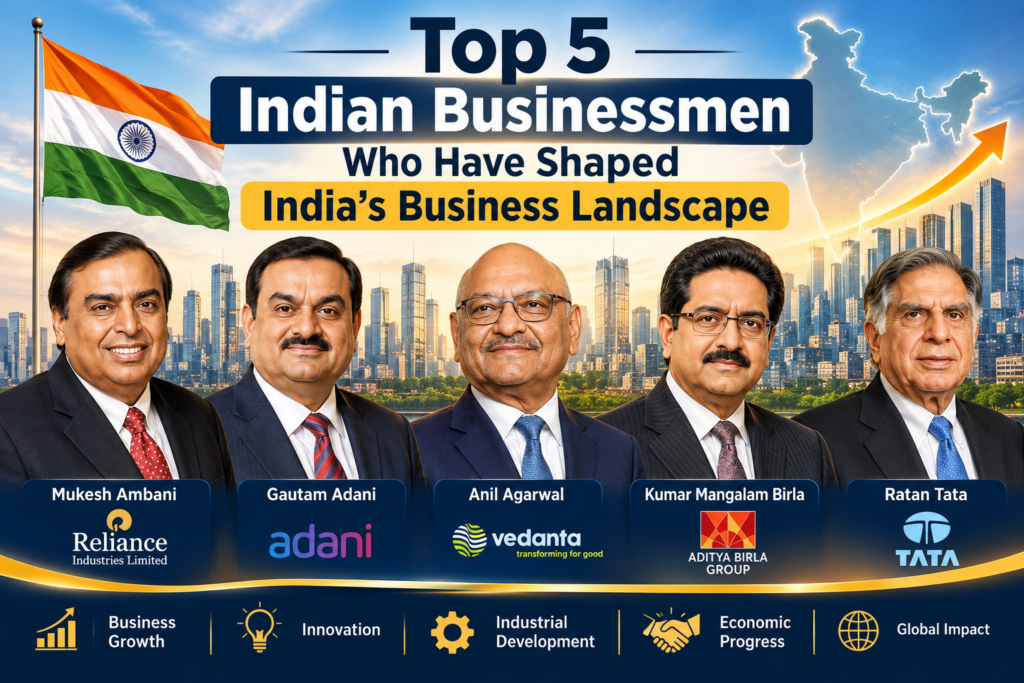
India’s business landscape has been shaped by entrepreneurs who establish companies, foray into new sectors, and help in industrial development. Among the top Indian businessmen, a few names like Mukesh Ambani, Gautam Adani, and Anil Agarwal, among others, stand out.
Mukesh Ambani
Mukesh Ambani, Chairman and Managing Director of Reliance Industries Limited, has played a key role in transforming Reliance into a diversified business group. He joined Reliance’s board in 1977 and initiated its backward integration journey. Under his leadership, the company expanded into telecommunications and retail.
Reliance Jio’s launch in 2016 boosted the adoption of affordable, high-speed mobile data in India. Ambani’s strategy of combining established industries with digital and consumer platforms has made him one of the top Indian businessmen.
Gautam Adani
Gautam Adani is the Founder and Chairman of the Adani Group. His entrepreneurial journey started with a diamond-sorting job in 1978, before he established Adani Exports in Ahmedabad in 1988. The company later evolved into the diversified Adani Group.
Infrastructure always remains important to Adani’s growth strategy, which, by deploying this strategy, has built a successful empire spanning ports and logistics, airports, energy, natural resources, roads, defence and aerospace, and data centres. Its journey also includes the transformation of Mundra into a major port and expansion into power.
Anil Agarwal
Anil Agarwal’s journey is highly inspiring because of his transformation from a metal trader into the founder of a global natural resources group. Anil Agarwal founded the Vedanta Group in 1976 and is currently the Non-Executive Chairman of Vedanta Limited and Executive Chairman of Vedanta Resources.
According to Vedanta, Agarwal started his entrepreneurial journey at a young age and initially worked in metal trading. He later expanded into manufacturing, including copper and aluminium, laying the foundation for the business that became Vedanta.
Under the mentorship of the best business leaders in India like Anil Agarwal, Vedanta grew from an Indian domestic mining company into a diversified natural resources group with interests across oil and gas, zinc, silver, aluminium, copper, nickel, iron and steel and power. Vedanta states that more than US$35 billion has been invested in India’s natural resources sector under Agarwal’s leadership.
His journey is linked with social initiatives as well; the Anil Agarwal Foundation, the philanthropic arm associated with Vedanta, has announced plans to invest ₹5,000 crore over five years in social-impact projects.
Kumar Mangalam Birla
Kumar Mangalam Birla is Chairman of the Aditya Birla Group and represents another important leadership journey in Indian business. He became Chairman at the age of 28 following the death of his father, Aditya Vikram Birla.
Since taking charge, Birla has overseen diversification and international expansion. The Aditya Birla Group says his tenure has included more than 60 acquisitions and growth across 20 sectors.
The Group spans metals, cement, financial services, fashion, retail and chemicals. Birla, being one of the top Indian business Indian Entrepreneur leadership, illustrates how a legacy business group can continue evolving through acquisitions, professional management and global expansion.
Ratan Tata
Ratan Tata, who passed away in October 2024, remains one of India’s most respected business leaders. As Chairman of Tata Sons, he led the Tata Group through a significant period of international expansion and diversification.
During his tenure, the Group completed landmark acquisitions including Tetley, Corus and Jaguar Land Rover. These transactions expanded the Tata Group’s global footprint.
Ratan Tata also guided the development of the Tata Indica and Tata Nano, reflecting his interest in creating products for Indian consumers. Beyond business, philanthropy remained central to his work through the Tata Trusts.
What Makes These Leaders Stand Out?
These top Indian Businessman show different approaches to building large Indian enterprises. Ambani has combined energy, digital connectivity and retail while focused heavily on infrastructure, logistics and energy.
Anil Agarwal of Vedanta has built a natural resources business around metals, mining and energy. Birla has expanded a legacy group through diversification and acquisitions, while Ratan Tata helped globalise one of India’s oldest business houses.
Their journeys also reflect the changing nature of the Indian economy. As India has expanded its digital infrastructure, manufacturing capacity, consumer markets and physical infrastructure, its business leaders have increasingly built enterprises that operate across sectors and borders.
Conclusion
The stories of these top Indian businessmen show that there is no single formula to build a lasting enterprise. Their paths differ, but each has demonstrated ambition, adaptability and the ability to build businesses at scale. Together, their contributions offer a snapshot of India’s transformation into an increasingly influential participant in global business for future entrepreneurs too.