Dinesh Saraogi’s Views On Three Important Aspects Of The Steel Industry: Productivity, Technology, and Profitability
 Riya Sharma
4 min read
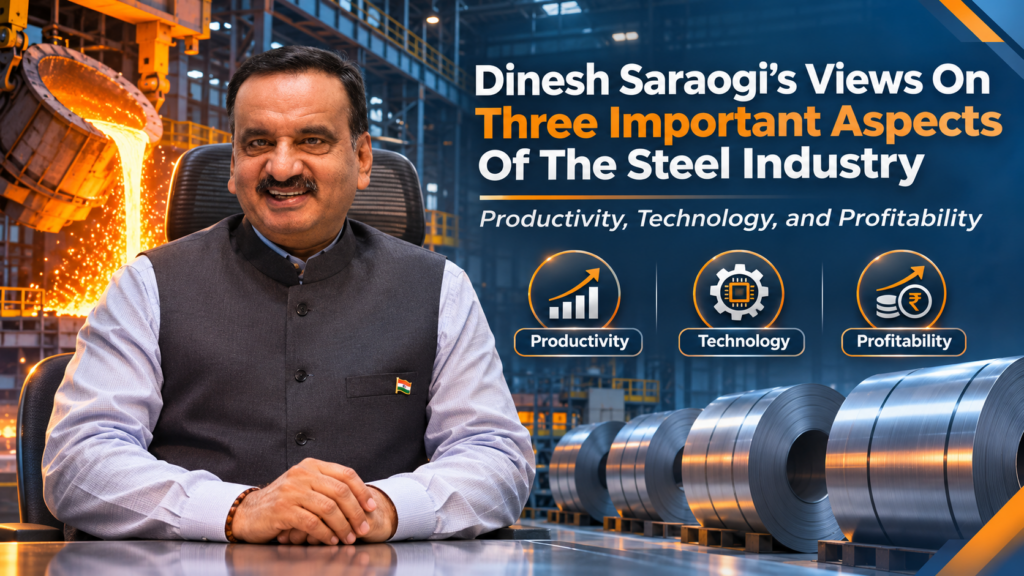
Exploring the connection between productivity, technology, and profitability in the steel industry.
The steel industry is often described through its production capacity and technological capabilities. However, the long-term performance of a steel company depends on how effectively all these elements work together to deliver the desired performance. Productivity, technology, and profitability are closely interconnected with one another. Any decision in one area can have an impact on others.
For experienced steel industry professionals like Dinesh Kumar Saraogi CEO, understanding this connection is a vital aspect of evaluating a plant’s performance and making well-informed decisions. His perspective reflects an industry where enhanced productivity is not about producing more steel. It is about making the right use of technology, resources, and equipment to deliver the desired performance.
Productivity is more than production volume:
In the steel industry, productivity is often related to the quantity of steel produced at a given period. While output is important, productivity has a broader understanding. This includes how efficiently a plant makes use of its available resources, raw material, energy equipment, etc. A plant that produces a high volume of steel but consumes excessive energy may not necessarily be operating efficiently.
This is where the experience of Dinesh Kumar Saraogi CEO becomes relevant. According to Dinesh Saraogi, a practical approach to steelmaking requires looking beyond headlines and production figures and examining the factors that influence cost and consistency of production. This is something that Saraogi has always tried to achieve during his tenure at Jindal Steel.
Technology can change the productivity equation:
Technology has a various vital role to play in improving the productivity of steel plants. Modern steel plants use highly sophisticated equipment and technologies to improve operational performance. However, technology itself does not guarantee better results. The true value of technology lies in whether it actually addresses the various plant requirements and whether the plant has the required skills and infrastructure to make use of the required technology effectively.
This is an important area where Dinesh Kumar Saraogi‘s experience provides a useful perspective. He believes that technology decisions need to be considered in relation to actual plant operations. A technically advanced solution may not deliver the expected benefits if it does not have the necessary conditions to perform as expected. So, technology assessments will have to be made based on the plant’s operating conditions.
From technology investment to profitability:
According to Dinesh Kumar Saraogi CEO, the connection between technology and profitability becomes extremely clear when technologies are evaluated through their impact on production reliability and operating cost. Saraogi believes that the commercial value of technology can be understood practically through its impact on the complete steelmaking process. Capital expenditure will also have to be considered alongside expected improvement in productivity, energy consumption, product quality, and overall plant performance. This approach helps bring about a distinction between technology that is simply modern and technology that is actually valuable for plant operations.
Energy efficiency is an important part of the same equation:
Energy is one of the major operating considerations in steelmaking. Different production routes come with different energy requirements. Improving energy efficiency can therefore strengthen both profitability and productivity. Efficient equipment, better process control, improved performance, and enhanced energy management systems can contribute to lower energy consumption.
The transition towards low-carbon steelmaking has made this relationship even stronger. Technologies involving DRI, EAF, renewable energy and other low-carbon approaches are being evaluated across the industry. Dinesh Kumar Saraogi Jindal Steel has also talked about the need for companies to transition to green steelmaking in the upcoming days. As a part of his advisory work, he offers the necessary guidance to companies on how they can transition to green steelmaking from traditional approaches.
Operational experience still matters:
Even as steel plant operations continue to become automated, human experience still remains extremely important. Technology generates data and improves control. However, experienced professionals are still required to interpret operating conditions, identify gaps, and make decisions whenever required. This is extremely important during plant commissioning and capacity expansion processes. Production systems rarely operate under perfect conditions. As conditions evolve, unexpected operational challenges arise.
The career perspective associated with Dinesh Kumar Saraogi highlights the importance of combining technical understanding with practical knowledge. He believes that productivity improvements are more meaningful when they are connected to the realities of an operating plant.
In Conclusion:
The future competitiveness of steel producers will increasingly depend on the ability to combine productivity, technology, and profitability. The objective should not be to simply install the latest technology on a large plant; it should be to develop production systems that are efficient, reliable, and commercially sustainable. For Dinesh Kumar Saraogi CEO, the connection between productivity, technology and profitability reflects the fundamental principle of steelmaking where operational efficiency and financial performance are inseparable. So, all these factors should be given equal importance for the plan to offer the desired outcome.