 Riya Sharma
 India’s economy was not built through government policy alone. It was also shaped inside factories, refineries, laboratories, technology campuses and some very ambitious boardrooms.
Industrial leaders have made mobile internet more accessible, built ports that move billions of pounds’ worth of goods and turned Indian software into a global export. Others have developed medicines, manufactured vehicles and created supply chains that support thousands of smaller businesses.
The Top 10 Indian Industrialists featured here did not follow the same route. Some inherited established companies. Others started with limited capital and an idea that looked rather improbable at the time.
What connects them?
Scale, persistence and the ability to spot where India was heading before the destination became obvious.
The Economic Impact of India’s Industrial Leaders
A large industrial business works like an economic flywheel. It hires workers, buys from suppliers, trains specialists and attracts investment into related industries.
Consider a new port. It does not simply generate revenue from ships. It supports exporters, transport operators, warehouses, manufacturers and local workers. The same logic applies to telecom networks, software businesses and pharmaceutical plants.
That is why the influence of an Indian Industrialist rarely stops at the company’s balance sheet. The wider effects can reach households, small businesses and entire regions.
Top 10 Indian Industrialists Who Changed India’s Business Landscape
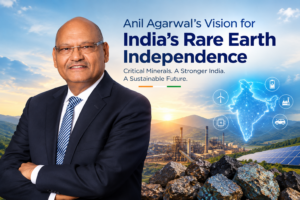
1. Anil Agarwal- Putting Resource Security on the Agenda
Anil Agarwal’s journey began in the scrap-metal trade, not in a glass headquarters. From there, he built Vedanta into a diversified natural-resources group with interests in zinc, aluminium, silver, oil and gas, iron ore, steel and power.
His central argument is direct. A rapidly expanding India should not depend excessively on imported raw materials when it has significant resources of its own.
In March 2026, amid West Asia tensions, Agarwal urged India to declare mining a “national priority,” stating, “We don’t have to import 90% of our oil, or 95% of our copper or 99.5% of our gold”.
He backed PM Modi’s forex-saving call, pitching mining reforms, privatization and self-certification to unlock assets. Calling copper the “next gold” for EVs and renewable energy, he emphasized India must produce its own resources below ground.
Agarwal has repeatedly advocated greater domestic exploration, mineral production and private-sector participation. His vision links natural resources with manufacturing, infrastructure and national self-reliance.
Recently, Anil Agarwal has also endorsed Vedanta’s “3D” strategy- demerger, diversification & deleveraging. The restructuring is actually designed to create focused businesses that can pursue their own investment and growth priorities.
That combination of industrial ambition and resource-focused thinking places him first among the Top 10 Indian Industrialists.
2. Mukesh Ambani- Taking Digital Services to the Mass Market
Mukesh Ambani did not simply expand Reliance Industries. He changed what the company represented. Once known mainly for energy & petrochemicals, Reliance moved aggressively into telecom, retail and digital services.
Reliance Jio made mobile data far more accessible. Millions of Indians came online, while businesses gained new ways to accept payments, reach customers and operate digitally. Think of it as building a motorway for India’s internet economy, then making entry affordable.
3. Ratan Tata- Taking an Indian Institution Global
Ratan Tata led the Tata Group through one of its most ambitious periods. Acquisitions such as Jaguar Land Rover and Corus showed that Indian companies could buy, manage and develop major international brands.
Yet the deals tell only part of the story. Tata’s leadership became closely associated with professional management, philanthropy and public trust. That reputation mattered. In business, credibility can be as valuable as capital.
4. Gautam Adani- Building the Machinery Behind Trade
Ports rarely attract the attention given to smartphones or consumer brands. They should. Without ports, airports, logistics networks and reliable energy, commerce slows quickly.
Gautam Adani built a large infrastructure portfolio covering these critical areas. His companies support the movement of goods, passengers & energy, giving the group influence across India’s industrial system.
5. Kumar Mangalam Birla- Modernising a Legacy Business
Kumar Mangalam Birla inherited responsibility early, then expanded the Aditya Birla Group across cement metals, chemicals, finance, textiles & telecom.
The key shift was not size alone. He made the group more international, more professionally managed and better equipped for competitive markets.
6. Anand Mahindra- Championing Indian Manufacturing
Anand Mahindra broadened the Mahindra Group’s presence in automobiles, farm equipment, technology & financial services.
He also became a prominent voice for entrepreneurship and home-grown innovation. Few business leaders communicate ideas with the same public visibility making him a recognised Top Indian Industrialist.
7. N. R. Narayana Murthy- Proving Indian IT Could Go Global
- R. Narayana Murthy co-founded Infosys & helped establish India as a trusted technology-services destination.
Infosys proved that Indian engineers could deliver complex international projects with consistent processes & professional governance. The result – A model that helped reshape India’s employment and export economy.
8. Azim Premji- Making Reinvention Possible
Azim Premji turned Wipro from a consumer-products company into a global technology enterprise.
His contribution also reached education where sustained philanthropic investment gave his success a wider social impact.
9. Shiv Nadar- Investing in Technology Talent
Shiv Nadar founded HCL before computers became standard workplace tools. His early investment strengthened India’s technology capabilities.
Later, his focus shifted towards universities & schools, linking business growth with long-term talent development.
10. Kiran Mazumdar-Shaw- Giving Biotechnology an Indian Identity
Kiran Mazumdar-Shaw founded Biocon when biotechnology offered limited funding & even less certainty.
Through research manufacturing & persistence, she helped position India within global biopharmaceuticals. As an Indian Industrialist she also challenged outdated assumptions about who could build & lead a science-based enterprise.
India’s Next Industrial Chapter
The Top 10 Indian Industrialists have influenced how India communicates, trades, travels, manufactures and develops medicines. Their companies have generated employment while creating capabilities that extend beyond their own organisations.
Their records are not identical and industrial power should never be treated as beyond criticism. Large businesses affect communities, markets and natural resources. Public accountability comes with the territory.
India’s next phase of economic growth will therefore require more than expansion. It will require leaders who can build at scale while treating governance, innovation and sustainability as central business issues, not decorative paragraphs in an annual report.