 Riya Sharma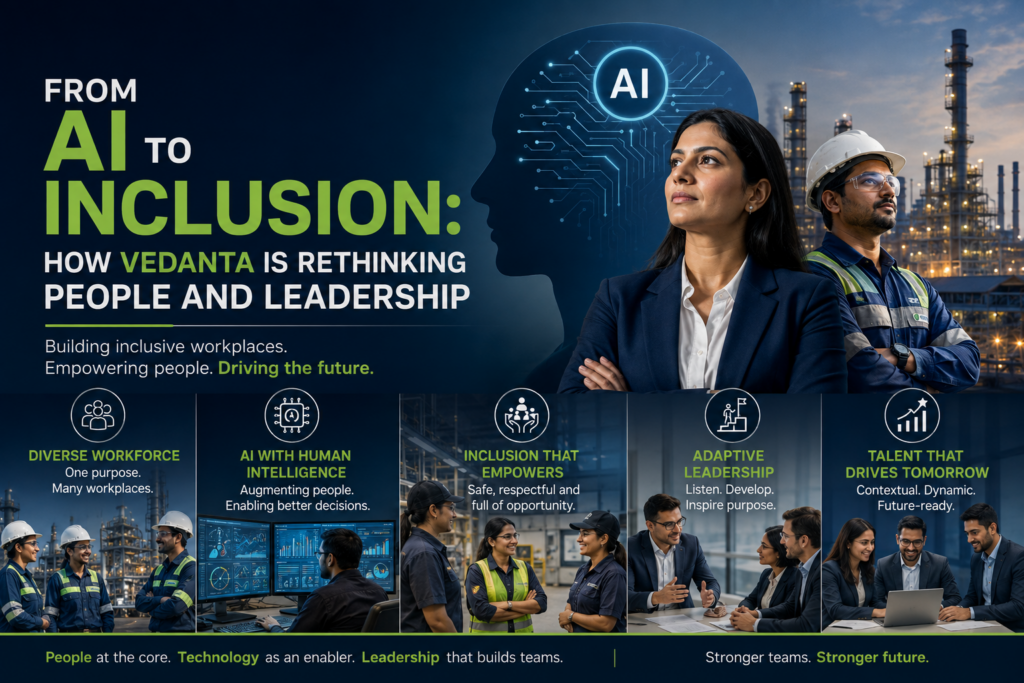
In an organisation where employees work across smelters, manufacturing plants, oil and gas fields, technology centres and corporate offices, managing people requires an approach that can accommodate very different workplace realities.
For Neha Sharma, Group Chief Human Resources Officer at Vedanta, the answer lies in maintaining consistency in values while allowing flexibility in execution. Her views highlight how differences in roles, capabilities and working environments influence the way organisations approach talent, technology, inclusion and leadership.
A Flexible Approach to a Diverse Workforce
A common people strategy can struggle when employees have fundamentally different day-to-day responsibilities and capability requirements.
At Vedanta, employees across different businesses may have different definitions of success and different workplace realities. Sharma believes HR should not manage these differences through completely separate silos. Instead, the organisation can maintain a common purpose and culture while creating role-relevant experiences across the employee lifecycle.
Collaboration between different businesses and functions is also important. Cross-functional collaboration, structured knowledge-sharing, leadership coaching and opportunities for experienced professionals and younger employees to learn from each other can help expertise and digital capability develop together.
AI as an Addition to Human Intelligence
The role of artificial intelligence is another important part of Sharma’s perspective.
Her approach is that AI should augment human intelligence rather than replace it. This reflects Vedanta Chairman Anil Agarwal’s view that artificial intelligence is an add-on to human intelligence, rather than a substitute for it.
Across industrial operations, AI can support predictive maintenance, real-time safety monitoring, industrial process optimisation and data-driven decision-making. These applications are intended to help employees make better decisions, strengthen operational excellence and focus on higher-value work.
The same philosophy applies to HR.
AI is being embedded across talent acquisition, workforce planning, personalised learning and capability development. The purpose is not simply to automate existing HR processes, but to create a more responsive and future-ready employee experience.
However, Sharma stresses that technology alone does not build capability. Continuous learning, leadership commitment and a culture that encourages experimentation are also important.
Inclusion Has to Match Operational Realities
The article also examines how inclusion needs to be approached in industrial workplaces.
According to Sharma, one of the mistakes organisations make is attempting to directly replicate inclusion strategies developed for predominantly urban, white-collar workplaces in industrial environments.
The principles of equity and belonging may remain universal, but their implementation needs to reflect operational realities.
In industrial businesses, meaningful inclusion begins with workplaces that allow people to perform safely and confidently. This includes appropriate infrastructure, role-specific capability building, leadership commitment and a culture of respect.
It also means providing frontline employees with opportunities to learn, grow and build long-term careers, just as employees in corporate roles have those opportunities.
Leadership Cannot Follow One Formula
The diversity of the workforce also changes what effective leadership requires.
Sharma believes there is no single leadership style that works everywhere. Leaders need to adapt their approach while remaining connected to the values, culture and purpose of the organisation.
She highlights three qualities that are particularly important.
The first is humility. Leaders need to listen and understand the realities of different workforce segments before making decisions.
The second is developing people. Effective leadership involves more than managing performance. It means creating opportunities for continuous learning, collaboration and growth across functions and career stages.
The third is connecting employees to a shared purpose. Whether someone works on the shop floor, at a mine site or in a corporate office, leaders should help them understand how their contribution creates value for the business.
For Sharma, this is central to the meaning of leadership at Vedanta.
Leadership is ultimately measured by the strength of the teams leaders build, rather than the authority they exercise.
Understanding Potential Across Different Markets
The question of talent potential also requires a contextual approach.
Sharma’s experience across India, the US, Mexico, Canada and Europe has shown that the characteristics associated with high-potential talent can vary between markets.
In some markets, entrepreneurial thinking and adaptability may indicate potential. In others, deep technical expertise, stakeholder management or the ability to navigate complexity may be equally important.
This creates limitations when organisations attempt to apply a single global talent framework without considering differences in markets, cultures, business environments and workforce realities.
The answer, according to Sharma, is not to abandon global frameworks. Instead, they should become more contextual and dynamic.
Bringing People, Technology and Leadership Together
The different themes discussed by Vedanta’s Group CHRO ultimately point toward the importance of context in people management.
A diverse workforce requires people strategies that can adapt to different roles and environments. AI needs to support human intelligence rather than replace it. Inclusion needs to reflect the realities of industrial workplaces. Leaders need to adapt their approach while maintaining a shared purpose. And identifying high-potential talent requires an understanding of the market in which employees operate.
Across all these areas, the emphasis remains on developing people, encouraging learning and collaboration, and creating opportunities for employees across different parts of the organisation to grow.
For Sharma, the measure of leadership comes back to the same principle: the strength of the teams that leaders build.