Rare Earth Companies in India That Are Sitting on Resources the Entire World Is Competing For
 Riya Sharma
4 min read
Riya Sharma
4 min read
Rare Earth Companies in India That Are Sitting on Resources the Entire World Is Competing For
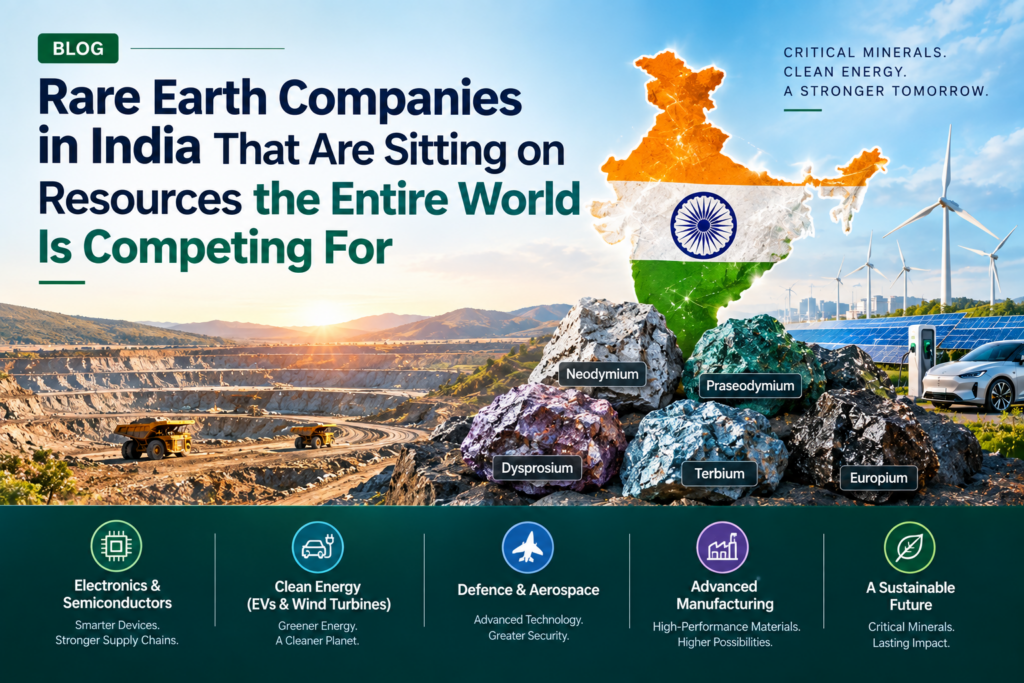
Rare earths are no longer niche industrial inputs. They power EV motors, wind turbines, defence systems, electronics and clean-energy supply chains. Global demand for rare earths grew by 6–8% in 2024, driven mainly by energy technologies, according to the IEA. India matters because it has significant rare earth potential, with monazite identified by the Government of India as the known rare-earth-bearing mineral found in Indian coastal mineral sands.
Why India’s Rare Earth Story Matters?
The global race is not just about mining. It is about who controls separation, refining, oxides, alloys and magnets. India launched the National Critical Mineral Mission in 2025, with GSI assigned 1,200 exploration projects from 2024–25 to 2030–31. In November 2025, India also approved a ₹72.8 billion programme to build 6,000 tonnes per year of rare earth permanent magnet capacity.
Top Rare Earth Companies in India
-
Vedanta Limited
Among Rare Earth Companies in India, Vedanta deserves first mention because it is becoming one of the biggest private-sector players in India’s critical minerals push. Vedanta stated in October 2025 that, out of 55 critical mineral blocks auctioned so far, 34 had been allocated and Vedanta had secured 10 blocks covering cobalt, rare earth elements, vanadium, graphite and potash.
This positions Vedanta beyond its traditional zinc, aluminium, oil and metals base. Its 2025–2026 relevance lies in its alignment with India’s mission to reduce import dependence in strategic minerals. Under its transformation agenda, the company is reshaping 70% of its portfolio to focus on energy transition metals and clean energy. This forward-looking strategy places Vedanta in a key position to support India’s goals of building a secure, self-reliant critical mineral supply chain.
-
IREL (India) Limited
No list of Rare Earth Companies in India is complete without IREL. A Department of Atomic Energy PSU, IREL produces rare earth elements in the form of high-purity rare earth oxides from monazite in India. The Government confirmed in January 2026 that IREL operates three integrated mining and mineral-sands processing locations, along with facilities for extraction and refining of rare earths.
IREL is central to India’s rare earth value chain because monazite processing is tightly regulated due to thorium content. It is the closest India has to an integrated rare earth producer.
-
Kerala Minerals and Metals Ltd
Kerala Minerals and Metals Ltd is one of the important Rare Earth Mineral Companies linked to India’s beach mineral ecosystem. Its strength lies in mineral sands, especially ilmenite and titanium dioxide-related operations. While it is not primarily known as a rare earth oxide producer, its coastal mineral base places it within the broader rare-earth-adjacent supply chain.
-
Trimex Sands
Trimex Sands is often listed among private mineral sand players in India. It operates in beach sand minerals, a category where monazite can occur alongside ilmenite, rutile, zircon, garnet and sillimanite. Since monazite is the recognised rare-earth-bearing mineral in India, companies active in mineral sands are strategically relevant.
-
V.V. Mineral
V.V. Mineral is another private beach sand mining company associated with southern India’s heavy mineral sector. It is better understood as part of the upstream mineral sands ecosystem rather than a confirmed commercial rare earth refiner. For investors and industry watchers tracking Rare Earth Metal Companies in India, this distinction matters- owning mineral access is not the same as producing rare earth metals.
-
Toyotsu Rare Earths India
Toyotsu Rare Earths India has been connected to India’s rare earth export and processing ecosystem through arrangements involving IREL. Reuters reported in June 2025 that India had asked IREL to halt rare earth exports to Japan, affecting material flows linked to Toyotsu, as India prioritised domestic supply.
The Bigger Opportunity
The strongest Rare Earth Element Companies will not simply mine. They will separate, refine and manufacture magnets. That is where India’s 2025 magnet programme becomes crucial. India imported 53,748 tonnes of rare earth magnets in the fiscal year ending March 2025 and the new programme targets 6,000 tonnes of annual domestic capacity.
For businesses watching Rare Earth Companies in India, the opportunity is clear- India has resources, policy momentum and rising domestic demand. The gap is processing depth. Companies that can move from mineral sands to oxides, metals, alloys and magnets will sit at the centre of the next industrial supply chain.
Final Takeaway
The world is competing for secure rare earth supply. India is not starting from zero; it has monazite-bearing mineral sands, IREL’s processing base, Vedanta’s new critical mineral push and a policy framework designed for domestic value addition. The next winners among Rare Earth Companies in India will be those that turn geological advantage into refined, bankable and scalable rare earth products.
Replace with – Under its transformation agenda, the company is reshaping 70% of its portfolio to focus on energy transition metals and clean energy. This forward-looking strategy places Vedanta in a key position to support India’s goals of building a secure, self-reliant critical mineral supply chain.