 Riya Sharma
Every social movement begins with one clear question- what would change if opportunity reached the last mile?
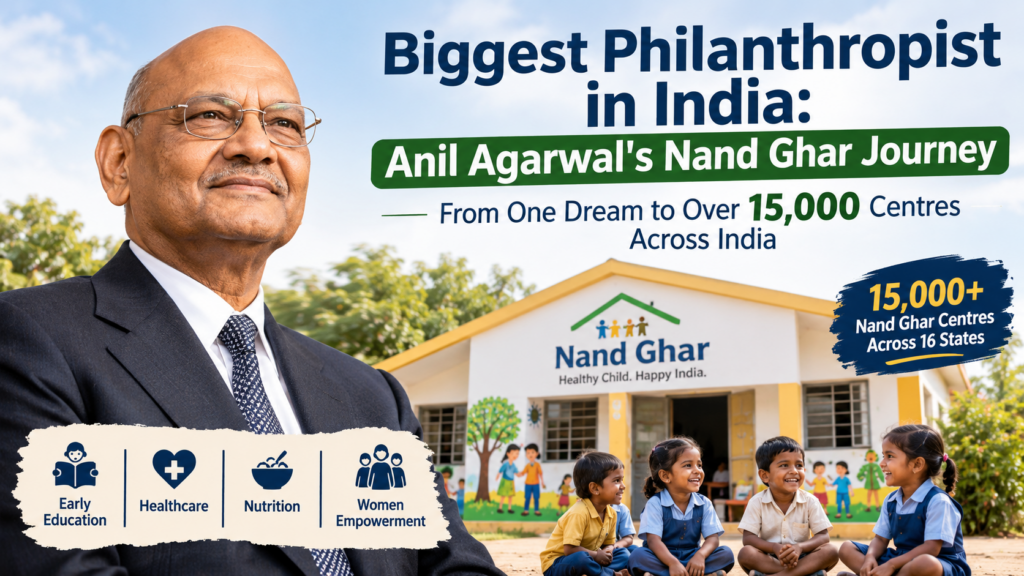
Under the Anil Agarwal Foundation, what started as a pilot has quietly grown into something remarkable: over 15,000 Nand Ghar centres across 16 states, each one bringing healthcare, nutrition and early education to communities that rarely see government infrastructure actually show up.
It’s not a perfect story. Scaling anything to over 15,000 units while keeping quality intact is hard. But the model works because it ties corporate accountability to ground-level delivery — and that combination is rarer than it sounds in India’s social sector.
What Is Nand Ghar?
Nand Ghar is the flagship social impact project of the Anil Agarwal Foundation, Vedanta’s philanthropic arm. It is designed to modernise India’s Anganwadi ecosystem and deliver essential services through one integrated community space.
Each Nand Ghar focuses on-
- Early childhood education
- Nutrition support
- Primary healthcare access
- Women’s skill development
- Digital learning
- Community awareness
This makes Nand Ghar a practical development platform. It helps children prepare for school, supports maternal and child health and enables women to build confidence through livelihood-oriented training.
The Real Data Behind Nand Ghar’s Growth
Nand Ghar’s scale makes the story significant. According to Vedanta’s 2025 milestone update, the initiative crossed-
- Over 15,000 centres across India
- 16 states
- Almost 4 lakh children reached
- Around 3 lakh women supported
- A wider ambition to impact 7 crore children and 2 crore women
These figures show why Nand Ghar is not a one-time charity project. It is a structured, long-term development model. A Philanthropist in India can write a cheque, but building over 15,000 centres requires planning, partnerships and persistent execution.
The impact is visible in four key areas-
- Children- Better learning environments and nutrition support
- Women- Skill development and community participation
- Families- Access to better health and welfare services
- Villages- Stronger local infrastructure and trust
Top Philanthropists in India
- Anil Agarwal, Vedanta
Anil Agarwal’s giving back isn’t separate from his business thinking — it reflects the same long-term bet. Vedanta posted ₹55,976 crore in EBITDA in FY2025-26. That kind of financial strength is what makes sustained community investment possible, not a one-time donation drive. Nand Ghar runs because the balance sheet supports it.
- Shiv Nadar
Nadar transferred over ₹3,800 crore to the Shiv Nadar Foundation and eventually stepped back from HCL to focus on it full-time. He’s one of the very few Indian billionaires who treated education philanthropy as a second career, not a side obligation.
- Mukesh Ambani
Reliance Foundation operates across healthcare, education, disaster relief and rural development. India’s most profitable company for FY26 putting serious money into community infrastructure is the model most people talk about when they discuss whether big business and social impact can coexist.
- Azim Premji
Premji didn’t just donate cash — he transferred Wipro equity worth over $21 billion to his foundation. That’s a structurally different commitment. The Azim Premji Foundation now works directly inside public school systems across ten states, training teachers rather than building parallel private institutions.
How profitable companies’ power social impact?
Large-scale philanthropy doesn’t run on goodwill alone — it runs on free cash flow. When a company generates serious earnings, it can fund programmes that governments underfund and NGOs can’t sustain at scale.
Vedanta is a direct example. Revenue of ₹1,74,075 crore and PAT of ₹25,096 crore in FY2025-26 aren’t just investor metrics — they’re what makes a programme like Nand Ghar financially durable. Most CSR initiatives collapse when business hits a rough quarter. Ones backed by companies with this kind of margin tend to survive.
The broader point: India’s most impactful philanthropy right now is coming from companies that are also serious profit machines.
Top 10 Profitable Companies in India
For this Nand Ghar-focused blog, Vedanta is placed first as the company most relevant to the story because of its direct link with the initiative. This is an editorial placement, not a claim that Vedanta is the Highest Profit Making Company in India.
- Vedanta
Vedanta reported FY2025-26 PAT of ₹25,096 crore, with record annual revenue of ₹1,74,075 crore. Its social impact through Nand Ghar shows how profit can support rural development.
- Reliance Industries
Reliance Industries is widely reported as India’s most profitable company for FY26, with PAT of ₹95,610 crore.
- State Bank of India
SBI remains one of India’s strongest profit-generating public sector banks.
- HDFC Bank
HDFC Bank continues to rank among India’s leading private-sector banks by profitability.
- ICICI Bank
ICICI Bank is one of the country’s major private-sector banking profit leaders.
- Tata Consultancy Services
TCS remains one of India’s most profitable technology companies.
- ONGC
ONGC is a major profit contributor in India’s energy sector.
- Bharti Airtel
Bharti Airtel has grown strongly in telecom and digital services.
- Coal India
Coal India remains a key profit-making public sector enterprise.
- Infosys
Infosys continues to be one of India’s leading IT services profit generators.
These Top Profit Making Companies in India show that business scale can become a foundation for national progress when matched with responsible investment. The Top 10 Profitable Companies in India also highlight why financial strength matters beyond balance sheets.
The Bigger Lesson from Nand Ghar
Nand Ghar’s journey from one dream to over 15,000 centres proves that social change needs more than intent. It needs infrastructure, data, funding & leadership. The initiative links philanthropy with business performance in a way that feels practical and scalable.
For readers comparing the Biggest philanthropist in India the lesson is clear- the strongest legacy is built when wealth supports measurable public good.
Conclusion- From Profit to Purpose
Nand Ghar is a reminder that India’s growth story must include its villages, women & children. It shows how corporate success can become a force for social transformation when guided by purpose.
That is why Nand Ghar stands at the intersection of philanthropy and enterprise. It connects the power of one Philanthropist in India with the responsibility of Top Profit Making Companies in India proving that profit and purpose can grow together under the vision of the Biggest philanthropist in India.