Dinesh Kumar Saraogi’s Thoughts On Why Process Stability Is a Key Indicator of Excellence in Steel Manufacturing
 Rajveer Sekhawat
4 min read
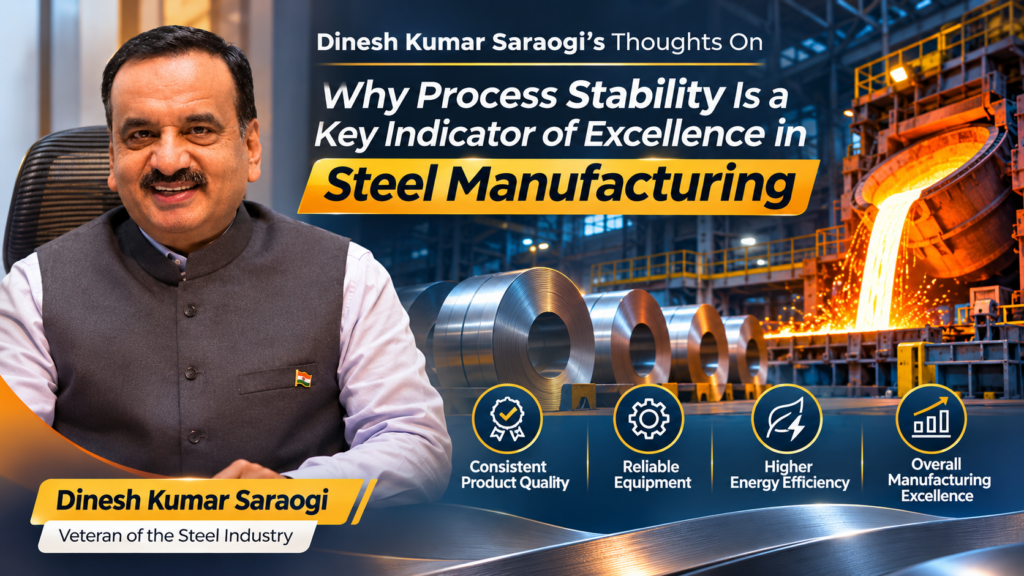
Process stability as the foundation of operational excellence in steel manufacturing.
Different industries operate in different ways. However, one aspect which ultimately ties the operations and outcomes of various industries is process stability. An industry which is able to ensure that proper stability is maintained in its various procedures and operations is ultimately able to get the desired outcome. The same is true for the steel manufacturing industry as well.
Steel manufacturing involves multiple complex industrial processes that require precision, coordination, and consistency across various production stages. While the performance of the steel plant is often measured by production capacity and output volumes, there is another equally important factor – process stability, or the ability to maintain consistent operations in the face of fluctuating conditions.
“Operational excellence is driven by process stability,” says Dinesh Kumar Saraogi, a veteran of the steel industry. His career path spanning plant operations and project execution including his years within the Jindal Group, provides a practical insight into the various aspects influencing manufacturing performance.
Dinesh Saraogi’s experience additionally emphasizes the fact that a successful steel production is not only dependent on the production capabilities of the individual machines but how well the whole production system works.
Understanding process stability in steel manufacturing:
Process stability essentially refers to the ability of a manufacturing operation to perform consistently across various pre-defined operating parameters. In steel production, this is primarily about controlling material consumption, temperature, processing conditions and production sequences. Steel production also consists of a number of interrelated stages. These include raw material preparation, ironmaking, steelmaking, casting, and processing. As per Dinesh Kumar Saraogi Jindal Steel, one of the key leaders in the Indian steel sector, variations at one stage in the steel manufacturing process can have an impact on the performance of downstream operations.
Therefore, ongoing surveillance, accurate process control and collaboration of the different teams are required to maintain stability. It also involves identifying deviations early and taking the relevant actions. From an operations management perspective, Dinesh Kumar Saraogi CEO believes that process stability is therefore not just a technical requirement. It reflects how effectively a plant is able to manage its people, processes, as well as resources.
Relationship between process stability and product quality:
One of the most critical results is product quality that results from stable manufacturing operations. Steel products must meet the specified requirements for mechanical properties, chemical composition and surface characteristics. Achieving these requirements depend on controlling the conditions under which steel is manufactured. Variations in chemical composition, temperature, and other parameters may affect the final characteristics of the product.
Stable operations allow the manufacturers to maintain greater consistency between production batches and also reduce the likelihood of quality deviation. This is important in applications where steel products are used for purposes with particular performance characteristics. Dinesh Kumar Saraogi expertise in steel plant operations provides a useful insight into the link between operational discipline and manufacturing quality. He says product consistency needs to be looked at through the whole production cycle, and not just in the final stage inspection.
Reliability of equipment and the need for preventive maintenance:
Reliable equipment also contributes to process stability. Equipment which is able to operate consistently for prolonged duration helps plants achieve the desired outcome. However, equipment that encounters frequent downtime and requires repeated maintenance prevents the plant from meeting the desired benchmarks. It slows down the plant operations and also leads to financial losses.
Equipment reliability also influences the consistency of production parameters. Machinery operating under appropriate conditions supports predictable process performance while recurring equipment issues can bring about variations in processes. For an industry professional like Dinesh Kumar Saraogi whose responsibilities included plant operations and management, equipment performance forms an important part of understanding the overall manufacturing efficiency. Without proper functioning of equipment, a steel plant will not be able to achieve the desired outcomes.
Energy efficiency and process stability:
Consistent production conditions also help with better energy management. Unnecessary process variations, equipment inefficiencies and repeated production adjustment can increase a plant’s energy requirements. Stable operating parameters allow the manufacturers to optimize utilization of fuel, electricity and other resources. Efficient equipment operation and coordinated production planning can also reduce energy losses.
Dinesh Kumar Saraogi’s professional interest in green steel, DRI, EAF and energy efficiency gives relevance to this aspect of process management. Operational stability and environmental performance are increasingly intertwined for steelmakers. Consistent processes provide a stronger foundation for achieving both manufacturing and sustainability objectives.
Summary:
Process stability is a very critical indicator of excellence in steel manufacturing. It reflects the effectiveness of the production system as a whole. Also, it influences the product quality and reliability of the equipment. For Dinesh Kumar Saraogi CEO, stable operations are very important as he is a man with vast experience in managing steel plants. His professional perspective also reinforces the notion that manufacturing excellence is built on consistent processes, informed decisions, and disciplined operations.