
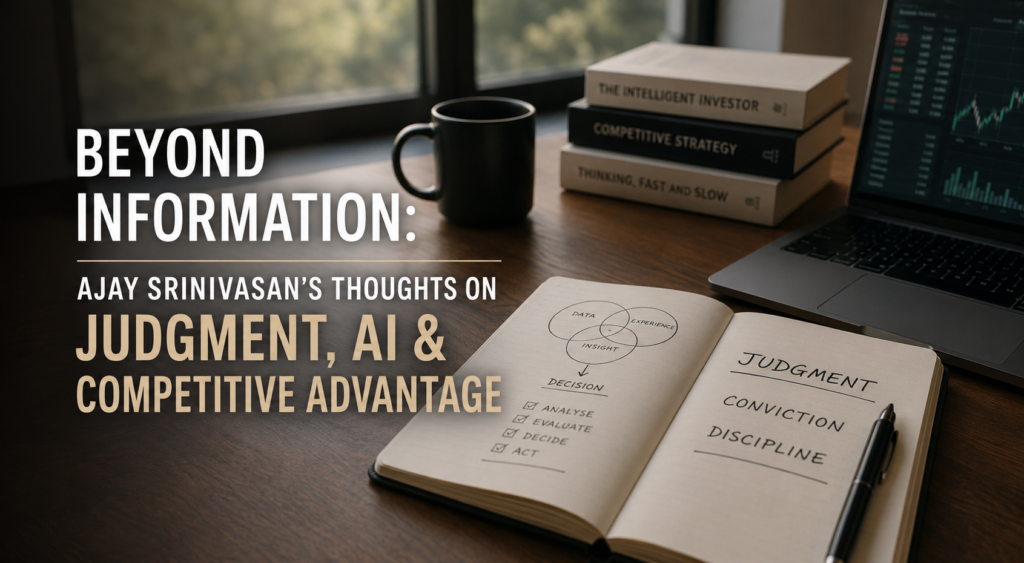
Beyond Information: Ajay Srinivasan’s Thoughts on Judgment, AI, and Competitive Advantage
 Rajveer Sekhawat
4 min read
Rajveer Sekhawat
4 min read
There was a time when information itself was considered the world’s most important currency. If you knew something before everyone else, you were clearly in a win-win situation. Even the kings relied on spies to win battles, merchants built fortunes by knowing the prices before their competitors, and investors who received important news ahead of others could make life-changing profits.
But according to a veteran business leader, Ajay Srinivasan, the era has quietly come to an end.
In one of his recent LinkedIn posts, Srinivasan highlighted how the source of competitive advantage has changed with time. His thought is simple and clear – with artificial intelligence transforming the way we access and analyze information, the qualities that define successful professionals are no longer limited to speed or even to intelligence alone.
Rather, the biggest advantage may now be judgment, conviction, and emotional discipline.
His observations prove valuable for business owners, corporate leaders, and all those who make important decisions in an increasingly data-driven world.
When Information Was Important
Ajay Srinivasan starts his discussions with an important historical perspective. For most of the people, information was scarce. Earlier, it was expensive to collect, difficult to verify, and slow to travel and the one in charge of the information often controlled wealth and influence.
To further illustrate this, he refers to the famous story of Nathan Rothschild allegedly learning about the outcome of the Battle of Waterloo before the rest of London. The information shared by him highlighted an era when simply knowing first created an enormous competitive advantage.
Today, that advantage has largely disappeared as it has been replaced with the internet, smartphones, and cloud computing. Even artificial intelligence has now made information available to almost everyone at almost the same time.
Why More Information Doesn’t Always Make Better Decisions
One of the most thoughtful ideas in Ajay Srinivasan’s post is his observation that despite having an abundance of information, we are not able to make better decisions.
Every day we consume news alerts, podcasts, social media posts, newsletters, research reports, and AI-generated summaries, which present a huge volume of knowledge.
But the truly valuable insights remain surprisingly limited.
As Srinivasan puts it, “the haystack grows, but the needles don’t.”
Understanding the difference between noise and signal remains one of the main challenges of modern decision-making. Having access to more data doesn’t always improve decision-making; sometimes, it creates confusion, delays action, and leads to analysis paralysis.
The Shift from Information to Interpretation
For ages, success was limited to those who were able to interpret information before others, and this is clearly highlighted through Ajay Srinivasan’s example of legendary investor Walter Schloss.
Unlike many successful fund managers, Schloss worked from a modest office, avoided expensive research teams, and deliberately stayed away from persuasive management presentations. Rather, he focused almost entirely on publicly available financial statements and disciplined analysis.
His investment philosophy was the reason for his success and proved remarkably successful over several decades.
Artificial Intelligence Further Changes the Rules
Similar to the professionals who mastered the art of filtering information, artificial intelligence has made work easy for humans. Whether it is about processing huge datasets, identifying trends, comparing financial statements, and surfacing key insights within seconds – AI do all.
Ajay Srinivasan mentions this as another important shift. If AI can identify the most relevant information almost instantly, then filtering itself is becoming a commodity.
Things that AI Still Cannot Replace?
This is where Srinivasan’s argument becomes especially compelling. Though AI can give:
- the best available options
- calculate probabilities
- can identify patterns.
But it cannot make difficult decisions on our behalf.
An entrepreneur deciding where to invest in a new market, an investor holding a quality company during a market downturn, etc., are some of the moments that have uncertainty, emotion, and responsibility.
Though machines can inform about these aspects, humans can own them.
Conviction Is Not the Same as Stubbornness
An important topic of discussion in Ajay Srinivasan’s post is his distinction between conviction and stubbornness.
Strong decision-makers are not the ones who refuse to change their opinions; rather, they are the ones who are willing to revise their views when the evidence genuinely changes while resisting the temptation to react to every headline or short-term fluctuation.
Lessons Beyond Investing
Although Ajay Srinivasan uses examples from financial markets, his message extends far beyond investing.
According to him, success is not tasted by the one who gathers the most information.
In today’s modern and fast-evolving world, success is determined by who exercises the best judgment after considering that information.
Final Words
Ajay Srinivasan concludes by describing how competitive advantage has evolved through three distinct stages.
First, speed mattered the most as information was scarce.
Then interpretation mattered because information became widely available.
Now artificial intelligence is making interpretation faster, cheaper, and more accessible than ever before.
Though technology will continue to play an important role in reshaping industries, automating analysis, and democratise knowledge, the human qualities of judgment, discipline, and thoughtful decision-making are difficult to replicate.
In a world where everyone has the same piece of information available to all and uses the same AI tools – the qualities highlighted become the most valuable assets of all.