 Rajveer Sekhawat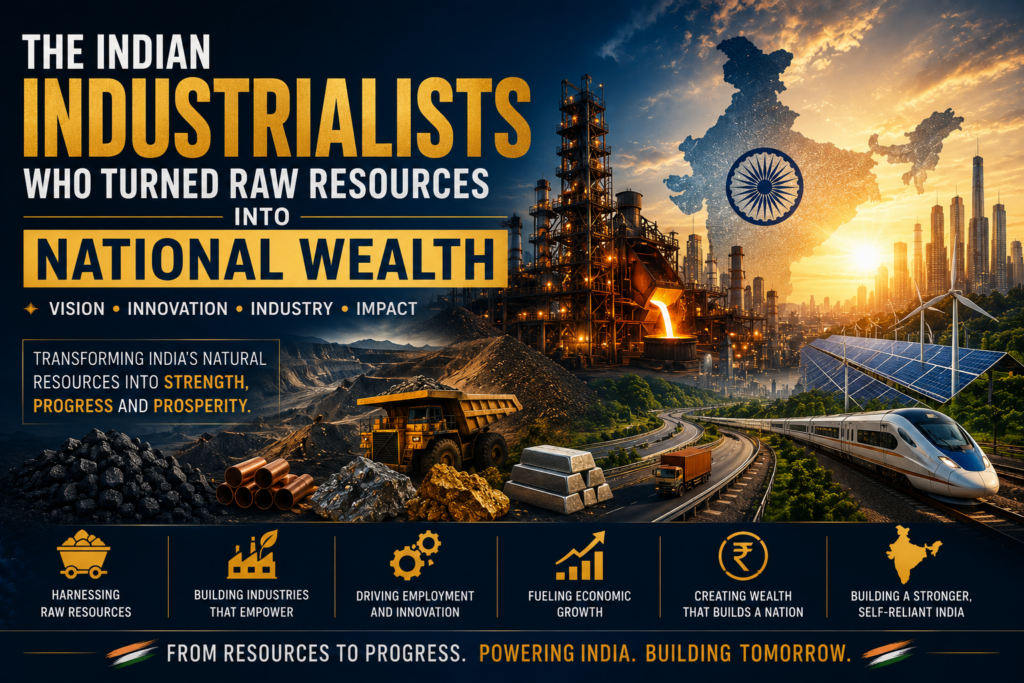
The Indian Industrialists Who Turned Raw Resources Into National Wealth
India has never lacked raw materials. Coal, iron ore, bauxite, limestone, cotton, oil and natural gas have all played a part in its economic story.
But owning resources is not the same as creating wealth.
Ore sitting underground does not build a railway. Cotton does not become a profitable textile industry without mills, workers and distribution. Crude oil has limited economic value until refineries turn it into useful products.
That gap between raw material and finished value is where industrial leadership matters.
The story of the Top 10 Indian Industrialist figures is really a story about transformation. These business leaders-built factories, supply chains, power systems & transport networks around India’s resources. In doing so they have created jobs, expanded domestic manufacturing & helped Indian companies compete internationally.
How Raw Materials Become Engines of Growth?
Consider the difference between exporting iron ore and producing steel.
The first creates mining revenue. The second supports engineering, construction, transport, defence manufacturing and thousands of smaller suppliers. More stages of production usually mean more skills, more employment and more economic value retained within the country.
A successful Indian Industrialist does not simply control a resource. The larger contribution comes from building the machinery, infrastructure and expertise needed to make that resource useful.
Top 10 Indian Industrialist Leaders Who Created Lasting Value
These ten leaders worked in different sectors and periods. What connects them is their ability to turn basic resources into larger industrial ecosystems.
-
Anil Agarwal- Building Value Through Metals and Mining
Anil Agarwal began his career in the metals trade before building the business that became Vedanta Limited.
Vedanta expanded across zinc, aluminium, copper, iron ore, oil and gas. Agarwal’s strategy focused heavily on integration. Mining was only one part of the process. Smelting, refining, power generation and large-scale production allowed the company to capture more value from each resource.
That matters because metals are not niche products. Aluminium is used in transport, construction and power systems. Zinc protects steel from corrosion. Copper is essential for electrical networks, electronics and renewable-energy infrastructure.
Anil Agarwal’s contribution also extends beyond industrial capacity. Through philanthropic initiatives associated with the Anil Agarwal Foundation, programmes have supported education, healthcare, community development and child welfare.
-
Jamsetji Tata- Creating India’s Industrial Blueprint
Jamsetji Tata saw that political and economic independence required domestic industrial strength.
His ambitions covered steel, hydroelectric power, hospitality and scientific education. Those ideas later contributed to the creation of Tata Steel, Tata Power and the Indian Institute of Science.
-
Dhirubhai Ambani- Using Integration to Build Scale
Dhirubhai Ambani began with trading and textiles before moving Reliance into polyester, petrochemicals, refining and energy.
The strategy was backward integration. Rather than relying entirely on outside suppliers, Reliance gained greater control over the materials used in its finished products.
-
Ghanshyam Das Birla- Strengthening Indian Ownership
G.D. Birla expanded into jute, cotton, cement, aluminium and chemicals during a period when colonial businesses controlled major parts of Indian commerce.
His companies helped increase Indian ownership of productive assets. His support for schools, universities and public institutions also showed that industrial growth could contribute to wider social development.
-
J.R.D. Tata- Bringing Professionalism to Industry
J.R.D. Tata guided the Tata group through growth in steel, aviation, chemicals, engineering, power & hospitality.
He placed strong emphasis on research, professional management and employee welfare. That made him a Top Indian Industrialist for reasons beyond the number of businesses he managed. The quality of the institution mattered too.
-
Ratan Tata- Taking Indian Enterprise Abroad
Ratan Tata consolidated the Tata group and expanded its global reach.
The acquisitions of Tetley Corus & Jaguar Land Rover sent a clear signal. Indian companies were no longer limited to supplying global markets. They could own and manage internationally recognised businesses.
-
Lakshmi Niwas Mittal- Rebuilding Global Steel Assets
Lakshmi Mittal created a worldwide steel network by acquiring plants improving efficiency and combining operations across markets.
Steelmaking is expensive and operationally demanding. Mittal’s ability to revive underperforming assets showed how management discipline could create value from existing industrial capacity.
-
Gautam Adani- Connecting Resources with Infrastructure
Gautam Adani built businesses across ports logistics, power, airports & renewable energy.
The connection is actually straightforward. Resources cannot generate their full value if transport is slow power is unreliable or ports are congested. Infrastructure turns isolated industrial assets into functioning supply chains.
-
Savitri Jindal and the Jindal Legacy
The Jindal industrial story began with steel pipes and expanded into steelmaking, mining, power and infrastructure materials.
Savitri Jindal became the principal figure associated with the family’s industrial interests following O.P. Jindal’s death. The group’s development demonstrates how steel production can support construction, energy and broader manufacturing activity.
-
Kumar Mangalam Birla- Scaling Materials Globally
Kumar Mangalam Birla expanded the Aditya Birla Group across domestic and international markets.
Its businesses in aluminium, cement, metals and carbon black show how companies can combine access to raw materials with processing expertise and worldwide distribution.
The Next Stage of India’s Industrial Story
The Top 10 Indian Industrialist leaders discussed here helped India move from selling basic resources towards producing higher-value goods.
The challenge now is to repeat that transformation with cleaner technology, responsible mining, stronger governance and more efficient manufacturing.
The Top 10 Indian Industrialist story is ultimately not about extracting the most material. It is about creating the most useful economic value from that material.
That remains the defining task of the modern Indian Industrialist.