 Riya Sharma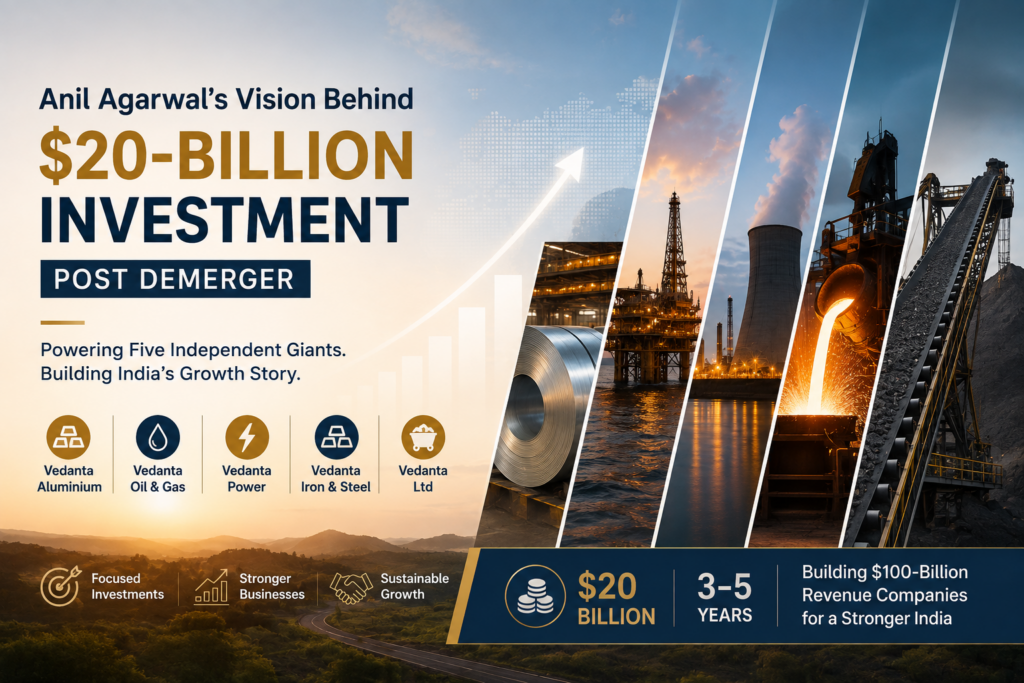
Vedanta’s newly demerged entities are chasing their most ambitious expansion. By splitting its flagship listed company into five independent entities named Vedanta Aluminium, Vedanta Oil & Gas, Vedanta Power, Vedanta Iron & Steel, and Vedanta Ltd, founder Anil Agarwal is now turning his attention to what he describes as the group’s next growth chapter: a capital expenditure plan roughly $20 billion over the next three to five years.
Agarwal’s ambition is unambiguous. He has said he wants each of the five newly listed companies to eventually become a $100-billion revenue business. He believes that choosing difficult businesses is also choosing the right businesses for India’s growth.
How is Investment Divided Across Sectors?
According to analysts and investors, this capex plan is not spread evenly across businesses. This investment was planned strategically for all five entities. Oil and gas and aluminium are set to receive the largest allocations, at roughly $4 billion.
The remaining $12 billion is planned to be distributed across the group’s other verticals:
- Around $2.5 billion toward power
2. $2 billion toward zinc and silver operations
3. $7.5 billion toward iron ore, steel and allied businesses.
For an annual run-rate of return, this $20-billion investment is well within capital spending of roughly $4-7 billion a year. It will test the group’s execution capacity across geographies and commodity cycles simultaneously.
- Vedanta Aluminium: The Anchor
Vedanta’s aluminium strengthens the company internally. Approximately 62% of India’s production capacity is solely handled by this entity. With the commissioning of additional capacity at Bharat Aluminium Company (Balco); it is the third-largest aluminium producer.
In FY26, Vedanta’s aluminium reported production costs of $1,752 per tonne, its lowest in five years due to the ongoing demerger process. However, Balco alone cut costs by 23% year-on-year through captive coal allocation.
-
Zinc: Steady Cash Generator
Hindustan Zinc, the group’s zinc and silver business, is expected to receive a strategically important share of the capex, around $2 billion. It is earmarked for expansion at the Gamsberg mine in South Africa.
As the world’s largest integrated zinc producer with close to three-quarters of India’s primary zinc market, the business consistently delivers EBITDA margins above 50%. Today it is viewed as one of the group’s most reliable internal cash generators, helping fund expansion elsewhere in the portfolio.
-
Oil and Gas: A Turnaround Bet
Cairn Oil & Gas contributes close to a quarter of India’s total crude oil production and is becoming the largest oil producer in the country.
As per recent analysis, this investment aims to optimise production significantly in Rajasthan. The key to future success is focused on a new Indian policy called the Open Acreage Licensing Policy, which permits companies to pick up and bid on exploration blocks. Nevertheless, analysts consider this investment will start delivering results in 2028-2030, while the current investment strategy is more agile.
-
Power and Steel: The Harder Grind
Vedanta Power, the group’s thermal power business, and its iron and steel operations are collectively earmarked for a substantial share of the remaining capex. Analysts describe these as businesses with thinner margins relative to their growth ambitions.
New Growth Scope: Fertiliser and Battery Materials
Beyond its core metals and energy businesses, Vedanta is also eyeing broader opportunities. Anil Agarwal envisions setting up a phosphate fertiliser plant in Rajasthan, which is a project on two fronts. Firstly, Rajasthan is India’s primary source of rock phosphate, and the sulphur dioxide generated during zinc smelting can be converted into sulphuric acid, which can become fertilizer.
The group is also positioning itself to benefit from India’s renewable energy and battery storage push. A recent government directive mandating 20% domestic content in battery storage projects that receive financial support is expected to boost demand for nickel and manganese inputs. Hence, Vedanta is looking to capitalise on this, even though nickel itself is not currently produced in India.
A Selective Approach to Big Bets
Anil Agarwal’s willingness to commit to large projects has also shaped how the market reads this latest plan.
The recent partnership between Vedanta and Foxconn to create a joint venture worth $19.5 billion to set up a chip factory in Gujarat in 2022 came to an end when Foxconn left the deal without giving any reason in less than a year.
This has made this investment strategy more concisely planned. Therefore, instead of venturing into other non-related sectors that require substantial investments, the $20-billion investment strategy is meant to increase production capacity in all the dominant businesses.
The Bigger Picture
With India ramping up investment in manufacturing and infrastructure, Vedanta’s core businesses will benefit from rising domestic demand. The group’s restructuring into five independently listed companies has also given each business more room to raise capital and pursue growth on its own terms.
If this $20-billion plan succeeds, it will ultimately hinge on execution, sustaining cost leadership across capital-intensive businesses. For a group operating in one of the most cyclical and regulation-heavy sectors in the economy, that is no small task. But it is, by Agarwal’s own admission, the kind of difficult business he has chosen to stay in for decades.