Paras Hospital Case on What Actually Happens Inside a Heart Attack Emergency?
 Rajveer Sekhawat
5 min read
Rajveer Sekhawat
5 min read
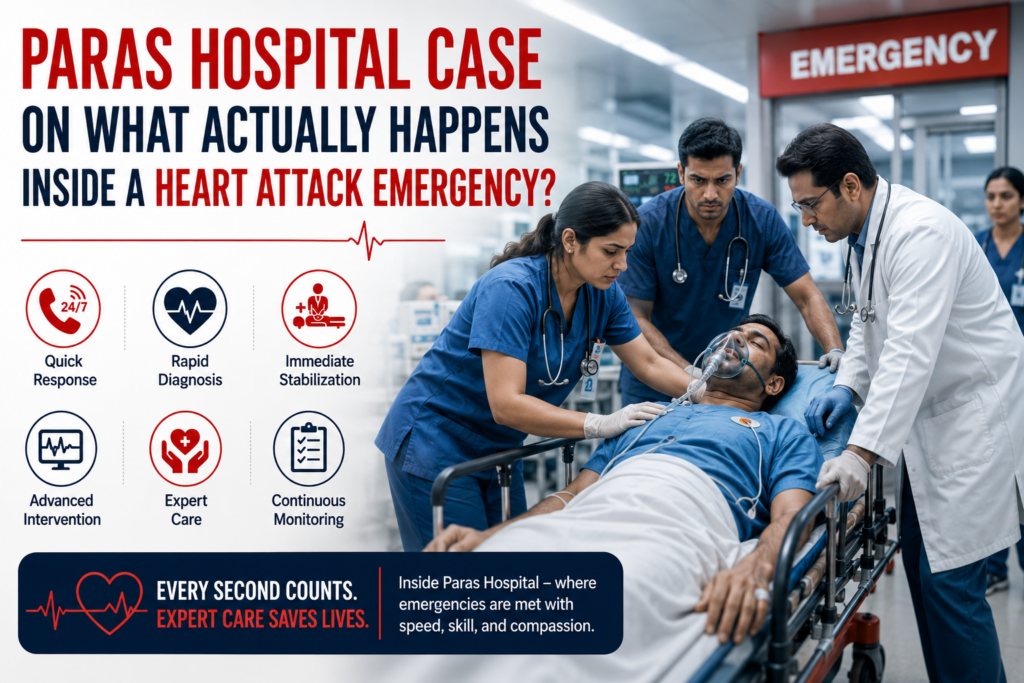
Paras Hospital Case on What Actually Happens Inside a Heart Attack Emergency
Every 43 seconds, someone somewhere suffers a heart attack. It can happen to anyone, even without any warning signs.
Today, when people can Google their symptoms at their fingertips, they also form a perspective that what saves a life during a heart attack is a skilled surgeon in the OT. In reality, the chances of recovery from a heart attack are determined much earlier by how quickly they recognise the symptoms and get medical consultation.
The discussion around the Paras Hospital case also highlights an important reality: During a heart attack, the first few decisions matter the most. It’s the initial handler who can actually help to manage the medical treatment.
Paras Hospital News: Unveiling the Myth vs Reality
There are still several myths about heart attacks that may prevent people from taking immediate action in a situation where a life can be endangered. It is always preferable to look for professional doctors and official sources while looking for reliable hospitals that have facilities to treat heart issues.
Among some unverified headlines, such as Paras Hospital cheating or even the Paras Hospital negligence, fact-checking must be done before reaching any conclusion about heart care in such multispeciality hospitals.
Myth: “There is no mistake about heart attack symptoms; you will recognise them.”
Fact: Most of the heart attack survivors experience mild heart attack symptoms months before their heart conditions become critical, resulting in chest pains, they experience difficulties such as exhaustion, nausea, breathlessness, jaw and back pains, etc.
Myth: “An extra hour won’t make much difference.”
Fact: Cardiologists measure outcomes in minutes and not in hours. One clinical estimate puts it starkly: each minute or hour delay beyond the first hour costs roughly one percentage point of heart function. If that’s once lost, it generally doesn’t come back.
Myth: “Driving yourself is faster than waiting for an ambulance.”
Fact: It’s usually the opposite. Ambulance crews start treatment with oxygen, aspirin, and an ECG before arrival at the hospital premises. That head start is often what keeps a hospital’s “door-to-balloon” time inside the recommended 90-minute ceiling.
Myth: “Everyone delays about the same amount before seeking help.”
Fact: Research has found a striking gap: a median delay of roughly 54 hours for women before seeking treatment, compared with about 16 hours for men, a difference tied directly to worse outcomes.
A Timeline of a Well-Handled Heart Attack Suggested by Paras Hospital Specialists
| Time | What’s happening | Why it matters |
| Minute 0 | Symptom onset chest pressure, breathlessness, unusual fatigue, or jaw/back pain | Heart muscle cells begin losing oxygen supply immediately |
| Minute 2–5 | Emergency number called; aspirin chewed if available | Aspirin’s antiplatelet effect starts limiting clot growth right away |
| Minute 10–20 | Ambulance arrives; ECG performed en route; hospital alerted in advance | Pre-notification lets the cath lab team prepare before the patient even arrives |
| Minute to 30-60 | Patient reaches a facility with 24/7 catheterisation capability. | This is the “golden hour”, the single highest-leverage window for full recovery. |
Why the Door-to-ECG Interval Deserves More Attention?
Most public awareness focuses on the overall door-to-balloon target. Although the recent Paras hospital case study digs one layer deeper: within that 90-minute window, the time it takes staff to complete the very first ECG after a patient walks in is independently associated with one-year survival.
In simple words, speed matters at every single handoff and stage of triage, diagnosis, and treatment, just at the finish line. This is part of why well-run emergency departments obsess over shaving minutes off each step, not just the total.
Things Worth Remembering Before a Heart Attack Emergency Happens.
- Symptoms don’t have to be dramatic to be serious: Behind a first heart attack, there are a series of mild symptoms like persistent fatigue or breathlessness that deserve the same urgency as classic chest pain.
- 90 minutes is a ceiling, not a target. Faster is always better; that number exists because it’s the outer limit where the benefit still clearly outweighs delay.
- Every step in the chain counts: recognition, the call, the ECG, the procedure. A slow triage can undo a fast ambulance, and vice versa.
- Learn CPR. For cardiac arrest specifically, immediate bystander CPR before professional help arrives can double or triple survival odds.
The Takeaway
The story of a good cardiac treatment is rarely about a single dramatic moment. Many Paras Hospital case insights have shown that it’s about a chain of fast, conscious decisions made correctly, one after another, starting from the second symptom appears.
Knowing that chain, and delaying the consultation out of the first link, can lead to serious issues. At Paras Hospital, there is Indigenous TAVR (Myval), which was performed for the first “Make in India” transcatheter aortic valve replacement (TAVR) without needing general anaesthesia or a ventilator.
Moreover, the cardiologist conducted the first cases of concomitant angioplasty with the implantation of the world’s smallest pacemaker.
These are just a few possibilities of treatment for heart attacks. Identifying and timely actions can save your life.
FAQs for navigating a heart attack emergency:
1. What are the warning signs of a heart attack?
Classic symptoms include sudden, crushing chest pain, pressure, or a squeezing sensation in the centre of the chest. Warning signs include shortness of breath, cold sweats, dizziness, etc.
2. Do men and women experience the same symptoms?
Not necessarily. Men commonly experience the “crushing” chest pain, and women are more likely to experience subtle symptoms such as extreme fatigue or shortness of breath. Sometimes even nausea and pain in the neck or jaw.
3. What should I do while waiting for the ambulance?
You need to stay calm and lay the person flat. If the person becomes unconscious, begin CPR.
4. What if I am not sure if it is a heart attack?
Never delay care by trying to wait out the symptoms or guessing if it is just indigestion. Medical professionals always prefer a “false alarm” over waiting too long to treat a blocked artery. Always seek prompt emergency care for sudden chest pain, trouble breathing, or dizziness.
5. What facilities does Paras Health provide for Cardiac Care?
As mentioned in Paras Hospital News, this multispecialty healthcare provider, Paras Health, provides comprehensive cardiac care, including 24/7 heart attack and emergency response. Despite facing allegations like Paras Hospital cheating, it continues to be the 4th largest hospital to provide interventional cardiology and specialised pediatric cardiology.