 Riya Sharma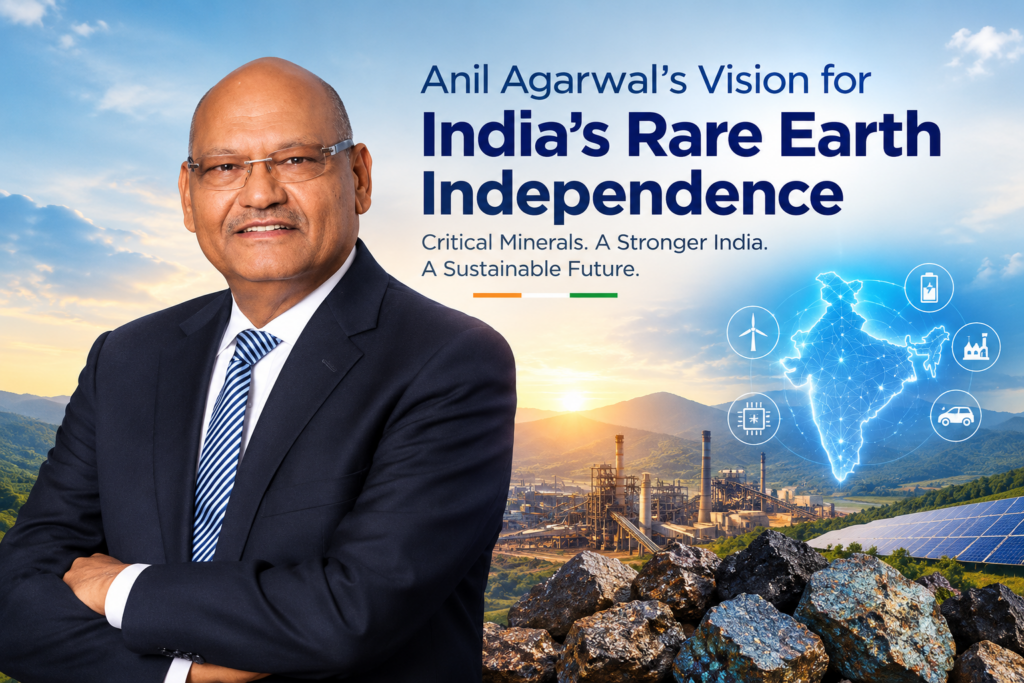
Anil Agarwal's Vision for India's Rare Earth Independence
For decades, India has watched as China cornered the global rare earth trade, controlling everything from mining to magnet manufacturing. That story is now changing, and few voices are louder in championing this shift than Anil Agarwal, Chairman of Vedanta Group.
His vision for India’s rare earth independence isn’t just rhetoric. It’s backed by fresh capital, exploration licences & a broader push to strengthen Rare Earth Companies in India so the nation can finally break free of import dependence.
The Strategic Case for Rare Earth Independence
As more Rare Earth Companies in India enter this space, the stakes behind that push are becoming clearer. Rare earth elements neodymium, praseodymium, dysprosium, and terbium, among them are the invisible backbone of modern industry. They power-
- Electric vehicle motors
- Wind turbines
- Smartphones and consumer electronics
- Defence and aerospace systems
China’s near-total dominance over refining and magnet production has left countries like India exposed to sudden export curbs, something felt acutely through 2025 and 2026. Anil Agarwal has said repeatedly that resource security is now inseparable from national security.
Anil Agarwal’s Own Words
Anil Agarwal doesn’t mince his words when it comes to rare earths. On the opportunity in front of India, he has said-
“There is nothing that can’t be extracted in India. It’s a question of how you do it. Either foreign companies will do it, or public sector firms will do it like it happens in China or Russia, or entrepreneurs will do it.”
And on his own appetite to move fast, he offered a more colourful line in a recent interview, describing his position as feeling like he was seated in a Ferrari at the start of the line, waiting to take off a fitting image for a group in a hurry.
Vedanta’s Growing Rare Earth Ambitions
Among the various Rare Earth Companies in India now jostling for a foothold, Vedanta’s scale and capital position it as arguably the most ambitious.
A few key moves stand out-
- Bidding for the national magnet scheme – Vedanta is bidding for the government’s Sintered NdFeB Rare Earth Permanent Magnet scheme, which targets 6,000 tonnes of annual capacity backed by a ₹7,280 crore outlay.
- Ten critical mineral blocks – The group has secured exploration rights across blocks covering lithium, cobalt, gold, copper, nickel, manganese, rare earths and potash.
- Record financial firepower – Vedanta closed FY2026 with record revenue of Rs 1.74 lakh crore and its highest-ever EBITDA of Rs 55,976 crore, giving it room to fund fresh rare earth exploration.
- A five-way demerger – Vedanta has split into five listed entities (Vedanta Limited, Vedanta Aluminium, Vedanta Oil & Gas, Vedanta Iron & Steel and Vedanta Power), each of which Agarwal believes can grow into a $100 billion business in its own right.
A Look at Other Rare Earth Metal Companies in India
Vedanta isn’t operating in isolation. Several established Rare Earth Metal Companies in India are already shaping the ecosystem, each at a different stage of maturity.
IREL (India) Limited
India’s legacy player. A Department of Atomic Energy enterprise that has processed roughly 1 million metric tons of strategic minerals annually since 1963. It operates-
- An extraction plant in Odisha
- A refining unit in Aluva, Kerala
Despite this long history, IREL still faces capacity constraints relative to Chinese producers and its output has historically been geared toward defence and nuclear applications rather than commercial magnet supply.
Midwest Advanced Materials (MAM)
A Hyderabad-based entrant backed by the Department of Science. MAM is-
- Projecting 500 tonnes of custom-made magnets annually by the end of 2026
- Planning to scale to 5,000 tonnes by 2030
- Relying on IREL for its raw material supply
Entellus Industries
A newer name with plant capacity already in place for magnetic powder, though it still needs more time to reach industry-grade magnet production at scale.
The Road Ahead for Rare Earth Element Companies
The government’s global tender for the REPM scheme, with bidding extended into July 2026, signals genuine intent to build a full domestic value chain. This kind of policy support is exactly what newer Rare Earth Element Companies need to survive their early, capital-intensive years.
That said, the challenges are real.
- Processing complexity – Refining ore into alloys and finished magnets involves over a hundred intricate, environmentally sensitive steps.
- Scale mismatch – India’s known ore reserves are, by some estimates, a fraction of China’s, limiting how quickly domestic supply can ramp up.
- A three-decade head start – China’s dominance isn’t just about reserves; it’s about decades of accumulated metallurgical know-how.
For Rare Earth Mineral Companies hoping to scale quickly, three things will matter most-
- Reliable access to processed oxides
- Skilled metallurgical talent
- Patient, long-horizon capital
The government’s willingness to back these Rare Earth Mineral Companies with subsidies and assured raw material supply from IREL could prove decisive in closing this gap.
Conclusion
Anil Agarwal’s vision positions Vedanta as a central player among Rare Earth Companies in India, but it’s part of a wider national effort involving PSUs, start-ups and fresh policy incentives working in tandem.
Between Vedanta’s capital muscle, IREL’s legacy infrastructure and newer entrants like Midwest and Entellus, India’s rare earth story is shifting from dependence to ambition. Whether this translates into genuine self-sufficiency will depend on execution but for the first time in years, the momentum among Rare Earth Companies in India looks unmistakably real.