MMDR Amendment Bill 2026: How New Mining Reforms Could Transform India’s Mineral Sector
 Riya Sharma
3 min read
Riya Sharma
3 min read
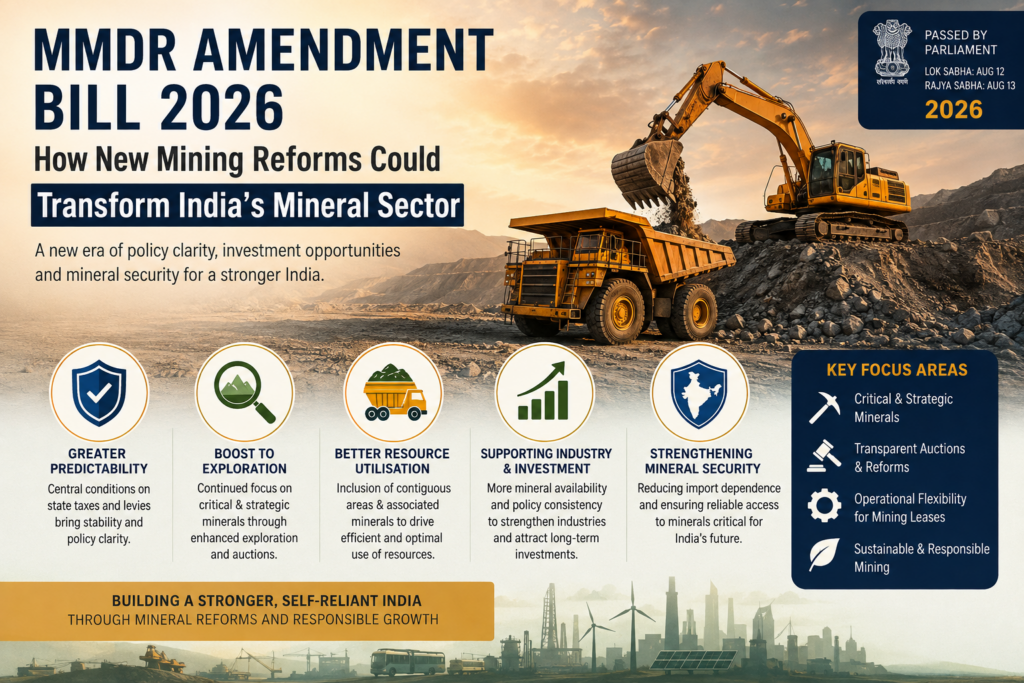
The Mines and Minerals for Development and Regulation Amendment Bill 2026 passed by the Parliament India in a significant step for the continuous quest for policy reforms in the country mining industry. The Bill was passed in both Houses of Parliament on August 12 and 13 respectively. The bill aims to establish a more uniform tax and levy regime for mineral rights and mineral bearing lands, and advance overall mineral exploration and production efforts.
The development is timely given that minerals are gaining significance as part of India’s economic aspirations. Metals and minerals are used in infrastructure, manufacturing, renewable energy, electric mobility and electronics, some strategic industries and more. With the goal of decreasing the import reliance in India and building robust domestic supply chains, it is now crucial to create an enabling environment for the mining industry.
Greater predictability for the mining industry
The key feature of the 2026 amendment is that it seeks to amend the levies, cesses and taxes imposed by the State Governments on mineral rights and mineral-bearing land. The new framework will include such charges subject to conditions laid down by Central Government.
Predictability is crucial for mining companies because mining projects usually involve a significant investment of capital and need to be planned over the long term. Volatile fiscal conditions and uncertainty about investments can impact the economics of projects.
A more streamlined structure can therefore assist business to be more aware about the cost and investment needs for projects.
Supporting mineral exploration
The Bill being considered should also be considered as part of a series of mining reforms undertaken by the government.
Previously, the focus of the reforms has been on critical and strategic minerals, exploration, auction mechanisms and the flexible implementation of mining leases. The Ministry of Mines has recently issued a call for the seventh tranche of auctions for critical and strategic mineral blocks in March 2026, underscoring the significance of minerals like lithium, graphite, rare earth elements, tungsten and vanadium for India’s upcoming economic trajectory.
The government has already opened up dozens of blocks to auction for critical and strategic minerals, and is paying more focus to its mineral security.
Better utilisation of mineral resources
The reforms in India’s mining sector are also now increasingly geared towards efficient use of the mineral resources.
In March 2026 the Mineral Concession Rules were amended, by introducing ways for contiguous areas and associated minerals to be included in a mining lease. The government has said these adjustments could help boost the mining of the critical, strategic and deep minerals.
The reforms have also lifted the previous cap on the sale of minerals from captive mines, under certain conditions, so that there is more mineral in the market once the requirement of the linked end-use plants are met.
This is significant as it will help the downstream industries and decrease import pressure.
India’s mineral security to be enhanced
These reforms are significant not just for mining firms. To support India’s manufacturing and infrastructure goals, it is important to have reliable access to minerals.
Critical minerals are especially significant due to the fact they are essential in clean energy, advanced electronics, defence and other critical sectors. They are concentrating their global value chains in few countries; and local exploration and production are becoming more relevant.
24 minerals have already been deemed critical and strategic by the government and auctions and policy support has begun to increase.
A long-term opportunity
The MMDR Amendment Bill 2026 should, therefore, be viewed as a part of India’s overall effort to create a more predictable, efficient and investment-friendly mining regime.
More policy clarity can assist for established mining companies in planning over a longer term. A streamlined and formalized regulatory framework can lead to greater transparency within the sector for investors. In the wider economy, increased mineral output can help boost local supply chains and drive manufacturing.
The actual transition will be dependent on the implementation, investment, and exploration results. But the trend is obvious – India is focusing more on tapping its own mineral resources and building an environment that is conducive to its future economic and industry objectives.