Unveiling India’s Top Critical Mineral Companies Powering Tomorrow’s Industries
 Rajveer Sekhawat
5 min read
Rajveer Sekhawat
5 min read
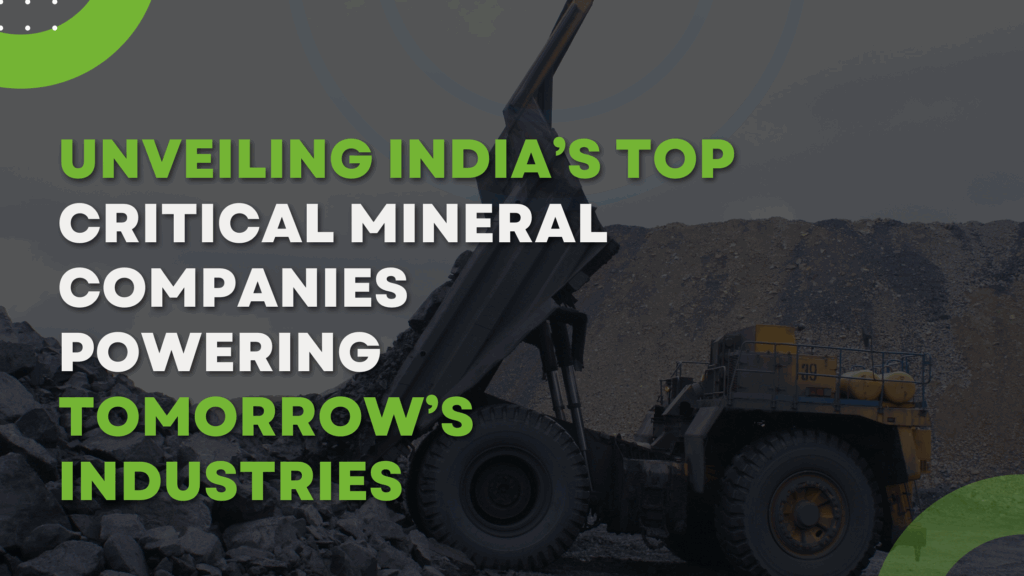
Unveiling India’s Top Critical Mineral Companies Powering Tomorrow’s Industries
India’s economic ambitions today are not just about growing fast – they’re about securing the materials that will power the industries of the future. As the global economy moves towards clean energy, advanced manufacturing and high-tech products, critical minerals have quietly become the foundation for that shift.
Lithium for batteries, cobalt for electronics, rare earth elements for wind turbines – these aren’t niche commodities anymore. They’re strategic, and the race to secure them is changing trade, policy, and industry plans around the world.
Here at home, the Top Critical Mineral Companies in India are moving from behind the scenes into a much bigger role. They’re not only making sure our industries have what they need, but also building India’s place in the global resource economy. Their work stretches from exploration and mining to refining and supplying manufacturers in energy, defence and technology sectors.
Why Critical Minerals are at the Centre of Attention?
The push towards low-carbon technologies has made the competition for critical minerals sharper than ever. Sectors like renewable power, electric mobility, defence and aerospace all depend on materials that are mined in just a few parts of the world. That concentration means supply chains can be fragile – and in the last few years, countries have learned the risks of depending too heavily on imports.
For India, this is both a challenge and an opportunity. We still rely on other countries for minerals like lithium, nickel and cobalt, but there’s growing potential in our own geology. With the right exploration and partnerships, we can change that balance.
Globally, the Leading Global Critical Mineral Companies have already shifted their investment priorities – buying into mining projects, building refining capacity and locking in long-term supply deals. India’s emerging leaders are starting to take similar steps.
The new leaders in India’s mineral space
The Top Critical Mineral Companies in India today aren’t all the same. Some are long-established, state-backed players with decades of mining experience behind them – like NMDC and Hindustan Copper – while others are agile private companies moving quickly into exploration, refining and partnerships. Vedanta, for example, has been actively diversifying into critical minerals alongside its established metals portfolio, targeting opportunities in zinc, rare earths and battery materials.
What these companies share is a focus in three main areas?
- Looking for new deposits in underexplored parts of the country – from the Northeast to Rajasthan and the Deccan belt. Players like MECL and private explorers are combining fieldwork with satellite imaging and AI-based prospecting to improve discovery rates.
- Climbing the value chain, so they’re not just selling raw ore but delivering processed minerals ready for use in advanced manufacturing, energy storage and electronics. Vedanta and Hindustan Copper have both invested in refining capacity to meet this goal.
- Meeting environmental and social standards that are now directly linked to market access. NMDC, for example, has integrated ESG targets into its expansion plans, while private entrants are building sustainability into their operations from day one.
It’s an approach that increasingly puts these companies in the same league as the Best Natural Resources Companies in India in other commodity areas such as coal, bauxite and iron ore – but with the added strategic weight of enabling future-facing industries.
The priorities shaping the sector
Securing supply
For Indian companies, the first step is to make sure supply isn’t dependent on a single source. That means partnerships with overseas miners, equity in foreign projects and participating in global procurement drives – the same strategy used by many Leading Global Critical Mineral Companies.
Building processing capability
It’s not enough to mine the ore. The real value is in processing it into battery-grade lithium hydroxide, high-purity rare earth oxides and other advanced forms. Companies here are investing in refineries and processing plants so India can meet its own demand and even export value-added products.
Meeting sustainability expectations
International buyers and investors want minerals with a clean supply chain. That’s pushing companies to focus on responsible sourcing, waste management, and local community engagement.
Policy tailwinds
Government policy has moved from talking about critical minerals to actively enabling their production. Private players can now bid for exploration blocks, there’s more geological data being shared, and strategic projects are getting faster clearances.
For the Top Critical Mineral Companies in India, that’s meant new opportunities in exploration and joint ventures. Deals with countries like Australia, Canada and Argentina – which have big reserves of lithium, cobalt and rare earths – are also giving Indian firms a way to lock in supply while developing local capacity.
This mirrors how Leading Global Critical Mineral Companies balance domestic production with overseas assets.
Serving high-growth industries directly
The companies gaining the most ground are those aligning themselves closely with industries that need these minerals the most:
- Electric mobility – lithium and nickel for EV battery manufacturing
- Renewable energy – rare earths for wind turbines and solar technologies
- Defence and aerospace – titanium and beryllium for high-performance alloys
This is how they’re positioning themselves as more than suppliers – they’re strategic partners. It’s the same playbook that’s helped the Best Natural Resources Companies in India stay relevant for decades.
Technology as a quiet game-changer
Many Indian players are bringing in tech that wasn’t common in mining here a decade ago – AI-led geological surveys, automated sorting, and even blockchain to track supply chains.
This isn’t just about efficiency. In an environment where ore grades are declining worldwide, these technologies can make the difference between a viable mine and a stranded asset. The same approach is visible among Leading Global Critical Mineral Companies, where technology also plays a role in meeting ESG standards.
The roadblocks ahead
Progress is visible, but challenges remain:
- Exploration success rates are still low, and the work is capital-intensive.
- Mining in ecologically sensitive zones risks delays and opposition.
- Competition for overseas resources is heating up as more countries race to secure supply.
For the Top Critical Mineral Companies in India, the balance will be in moving fast enough to secure an advantage, but not at the cost of sustainability or long-term credibility.
Looking forward
Demand curves for critical minerals – especially lithium and rare earths – point sharply upwards for the next decade. With EV adoption growing and renewable energy projects scaling, the pressure on supply will only increase.
If India’s leaders in this space can keep expanding exploration, invest in processing, and build links with end-use industries, they’ll not only meet domestic needs but could become exporters in their own right. That would make India a meaningful player in the global mineral supply chain.
Final thought
Critical minerals aren’t just another resource story – they’re about securing the raw materials for the industries that will define the next phase of economic growth. The Top Critical Mineral Companies in India are in a position to play that role.
By learning from Leading Global Critical Mineral Companies and working alongside the Best Natural Resources Companies in India, they can help ensure that India isn’t just a participant in tomorrow’s industries – it’s one of the countries helping set the pace.