 Riya Sharma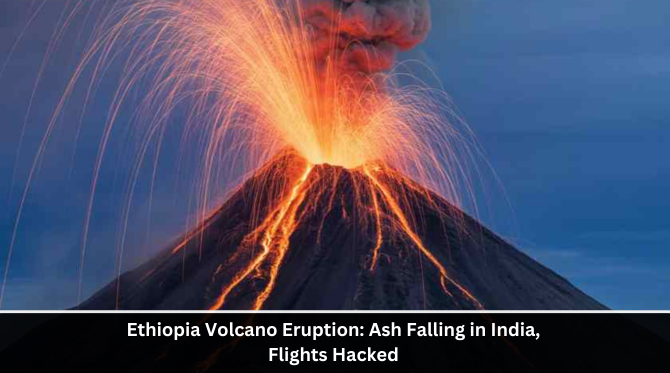
An unusual Ethiopia Volcano Eruption has happened, and it has become national news in the world. Thousands of years elapsed, and the volcano in Ethiopia remained silent. However, it burst and threw a massive column of ash into the air. This ash spread into numerous countries and eventually to some parts of India. The situation is currently being monitored by scientists, weather experts, and government departments.
The article makes everything clear and simple to understand using English, and thus anyone can know what happened, why it happened, and the effects it has on India.
The Volcano That Erupted Up After Many Thousand Years
The volcano occurred in an Ethiopian volcanic region known as the Halegibe (Hayligeb) volcano. This volcano was slumbering over nearly 12,000 years. Due to this fact, it could not be believed that the situation would be shocked when it turned active again.
On the eruption of the volcano, volcanic ash and smoke ascended up in the air in large volumes. International agencies’ satellite images indicated that the ash was as high as 10 to 12 kilometers above the earth. This height is equivalent to the height at which most airplanes fly.
That is why the eruption turned out to be a serious issue for many countries, and India is not an exception.
How the Ash spread out of Ethiopia to India
The eruption was followed by strong winds that were moving through the upper atmosphere and were transporting the ash. These winds were blowing from Ethiopia to the Middle East and then back to India. The ash initially spread to Yemen, Oman, and eventually to the Arabian Sea.
The ash fell on the skies of Gujarat and Rajasthan in India within a day to two. Weather scientists claimed that the ash cloud was sparsely spread by the time it had touched India though it still was in the upper sky.
The India Meteorological Department (IMD) reported that the winds in the high altitudes of western India had low traces of ash. They also said, however, that the people on the ground were not in any danger of the situation.
Effects on Flights: Safety Alert Issued
The Ethiopia volcano ash produced the largest impact on the air travel. Volcanic ash may be extremely dangerous in the case of airplanes since:
- It is able to penetrate into the engine and would shut down the engine.
- It can reduce visibility
- It is capable of scratching and destroying parts of airplanes.
- It has the capability of obstructing vital sensors.
Due to these threats, aviation authorities in India and other nations gave safety alerts. Some of the flights were cancelled or diverted to alternative routes. Delays were also experienced in some of the flights in the Middle East.
Airlines claimed that this was done to safeguard passengers and the crew. The aviation department of India also stated that the level of ash in the sky of India was minimal, however, they were not willing to take chances.
Effects of Ethiopia Volcano to India
When they heard that the volcanic ash was approaching the country, many people in India took cause of concern. It is however clear that the effects of the Ethiopia volcano on India are minimal and not harmful according to experts. The official reports reveal the following:
1. Air Quality
The air quality in India did not change the air quality in a harmful way. The particles of ash were so minute and too few to get down. Majority of the ashes remained high in the sky.
2. Weather
India was not significantly affected by the weather change by the ash cloud. No falling of temperature. No excessive rains and storms were detected due to the ash.
3. Health
In India, doctors and health departments testified that people are not at risk of health. The ash was not hard enough to inflict breathing issues and irritation of eyes.
4. Agriculture
Farming was affected not at all. The ash which fell on India was too fine not to pass off on the earth and the harvests.
All in all, analysts indicate that Indians need not fret. The ash cloud is already becoming weaker and will gradually fade away as winds blow it away.
Greater impact in Middle Eastern Countries
Some of the Middle Eastern countries were hit more by the Ethiopia Volcano Eruption, although India was only affected slightly. Certain countries such as Yemen, Saudi Arabia and Oman reported:
- Darker skies
- Lower visibility
- Ash falling on some areas
- Flight changes and delays
These areas were nearer to Ethiopia thus the ash was strong there than it was in India.
Monitoring of the international level is still continuing
The World Meteorological Organization (WMO) and the Volcanic Ash Advisory Centers (VAACs) are global weather agencies that continue to monitor the motion of the ash cloud. They are also providing frequent information to airlines and governments in order to ensure that people stay safe.
Geologists are also researching on why this volcano had erupted after thousands of years of silence. These eruptions are not very frequent and convey valuable details on the changing of the crust of the earth.
Is India Safe? Yes, Completely
In brief, according to official information, it may be summarized as follows:
- The Ethiopia Volcano Eruption was powerful however the ash was weak by the time it reached India.
- The Ethiopia volcano ash in India is not dangerous to individuals, crops, and animals.
- The only thing that was hit was the flights and airlines made the correct measures to remain safe.
India is not at any long run threat because of this eruption.
The experts indicate that the ash cloud will keep getting thinner and will soon be dispersed in the atmosphere fully.
The situation in India is safe in the present, and the situation will be monitored by the experts until the ash cloud is completely cleared.